How to Be Good at Research
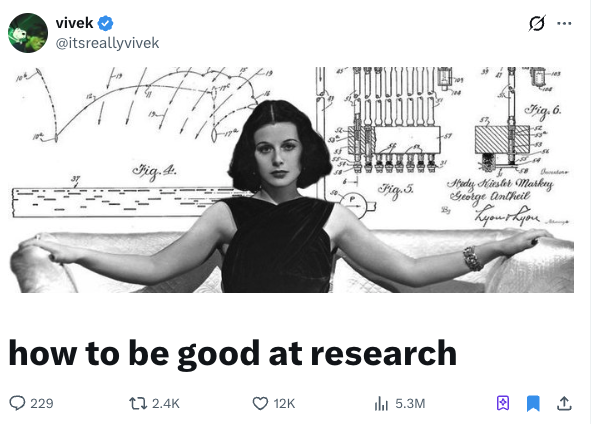
Link: https://x.com/itsreallyvivek/status/2064686372737454155
Research isn’t taught — it’s trained, little by little, through choosing your own problems, recording your mistakes, and tightening your feedback loops.
- Choose your own problems
- Upgrade your inputs
- Write everything down
- Tighten the loop
- Share at the outputs
- Wander on purpose
- Find your people
- The long game
How to Have Good Taste
Link: https://m.blog.naver.com/perspectiverse/224283575176
We live in an age that worships “taste” while quietly hoping it can be bought, borrowed, or downloaded. On May 12, 2026, in a packed hall at Chonnam National University, Min Hee-jin — the producer behind NewJeans — spent nearly two hours dismantling that hope, one student question at a time. What follows is a record of how she thinks about the one thing everyone wants and almost no one is willing to earn.
She begins, tellingly, by distancing herself from the word itself. “Aesthetic sense” has been overused to the point of being grating, she admits — yet her method is unambiguous. Taste is a sense, and like any sense it sharpens through practice, not talent. Watch a great deal, read a great deal, think a great deal — especially while you are young and your mind still absorbs like a sponge, taking in as wide a range of culture as it can hold. There is no shortcut, and the people who most want one are exactly the people who never develop the faculty.
The sharpest turn in her argument is also the most counterintuitive: never hand your standard of judgment to someone else. Leaning on other people’s opinions out of anxiety, she says, is a form of laziness — and that laziness dilutes the very judgment you are trying to build. The more you defer, the less of your own eye you will ever find. You have to construct the standard yourself.
From there she draws a distinction most of us blur — between personal taste and a level of completion that transcends it. There is work that may not be to your liking and that you still cannot honestly dismiss: a sophistication so high that preference becomes a secondary matter. “It may not be my style, but I have no choice but to acknowledge it.” Learning to feel that difference is the real work.
That distinction reframes a hierarchy people usually get wrong. The line between major and minor, she argues, is not one of noble versus common — difficulty does not make something noble, and ease does not make it base. It is a matter of sophistication, and good and bad coexist on both sides. Her own instinct has always been to find work that is minor only because it went unnoticed, and pull it up into the mainstream — she reaches for the figure of Mun Ik-jeom, who smuggled cotton seeds out of China because something that warm and useful belonged in ordinary lives.
Underneath all of it runs a single conviction: essence comes before business. When the fundamentals are of a high enough standard, the commercial logic follows almost as an afterthought; when the essence is shaken, no amount of marketing can hold a thing together for long. The energy of sincerity, she insists, moves people in a way no engineered virality can — and outlasts it.
A note of honesty, in her own spirit of directness: this is a transcript of one charismatic, self-assured person speaking off the cuff, and the chronicler who took these notes is openly of two minds — admiring the skill while wary of the self-mythology. Read it that way. Take the method, weigh the person, and keep your own judgment intact. That, after all, is precisely what she is telling you to do.